PRODUCT DESIGN / AI NATIVE TRIP.COM CONCEPT / MAY 2025

Seven days across Northern Xinjiang

Planning with AI,
not around AI.

A travel-planning agent that turns fuzzy intent into editable constraints, explains the trade-offs, and replans only the days that actually need to change.

Kanas Lake and autumn forest in Northern Xinjiang, photographed by Altankhuu Jorgutyn
KANAS · NORTHERN XINJIANGPHOTO © 2026 ALTANKHUU JORGUTYN
Role
Product designer + prototyper
Format
Self-initiated concept
Scope
Strategy, UX/UI, implementation
Status
Responsive interactive concept
ONE PRODUCT · THREE COMPOSITIONS

Responsive by task,
not by shrinking screens.

One planning system keeps its state and route logic intact, then recomposes around the traveller’s available space and attention.

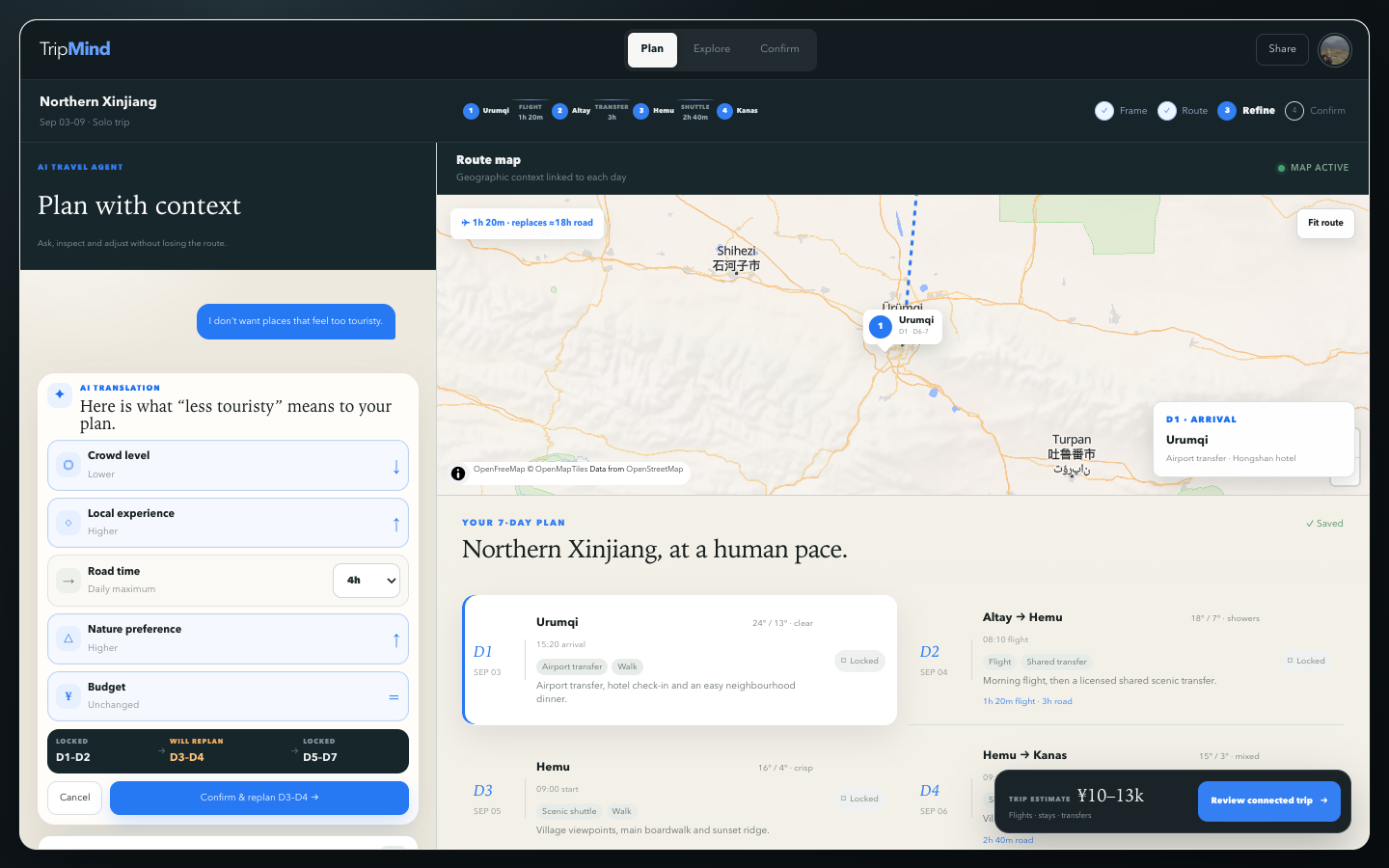
TripMind desktop interface with the AI planning conversation beside a live Northern Xinjiang map and route timeline
DESKTOP · 1440 × 900Reasoning at full scaleAgent, map and timeline stay visible together.
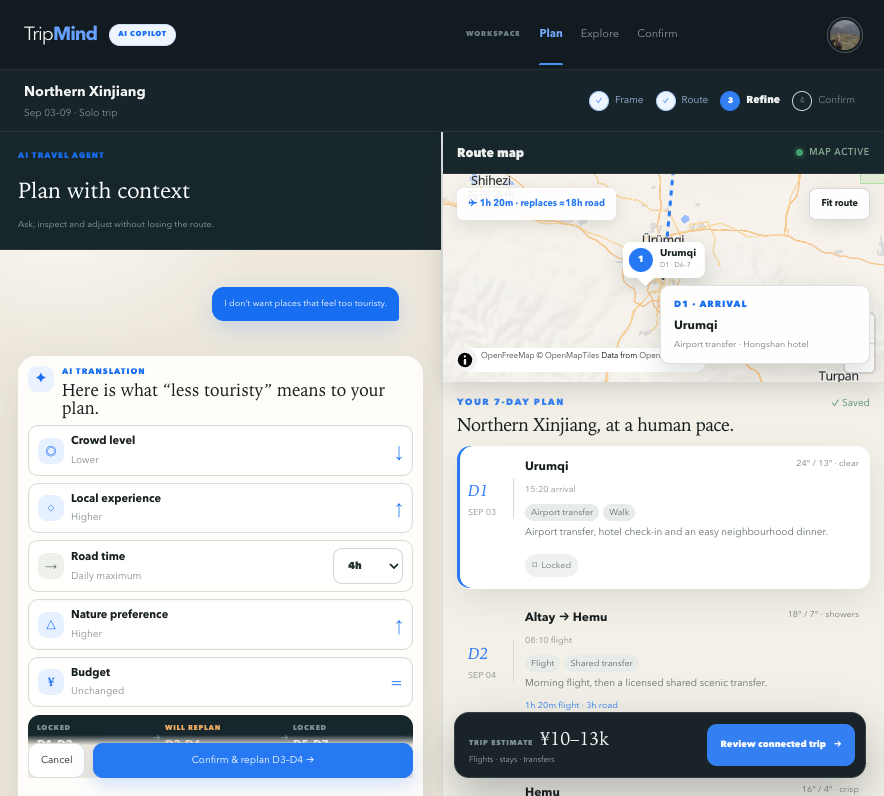
TripMind foldable interface with the AI agent on the left screen and the route workspace on the right screen
GALAXY Z FOLD7 · 2184 × 1968Two panes, one taskAgent left; route and feasibility right.
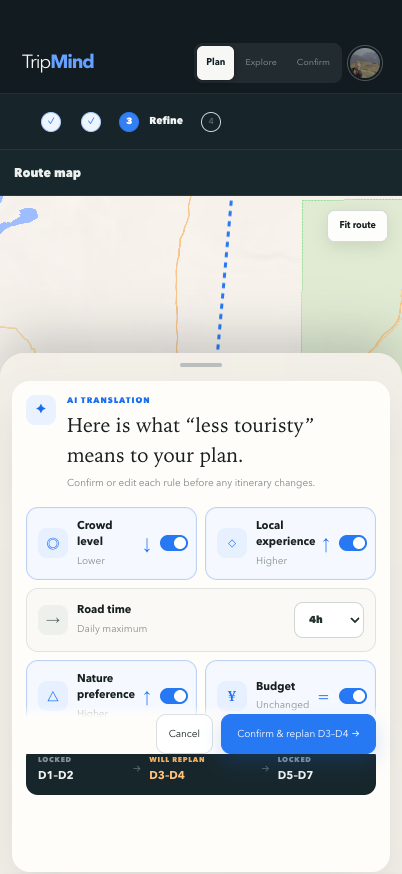
TripMind mobile interface with guided planning progress and a map-first route view
IPHONE 17 PRO · 402×874Map first, agent on callThe itinerary becomes a thumb-reachable sheet.

Seven days is not a duration.
It is a dependency graph.

Maya has seven days of annual leave, a comfortable but finite budget and no Chinese driving licence. She needs a feasible Northern Xinjiang route—not another itinerary that hides its assumptions.

01

Distance has no felt scale

Places that look adjacent may require hours of mountain-road travel.

02

Preference has no structure

“Not too touristy” affects timing, activity choice, transport and budget.

03

Generation has no stability

A new answer gives no confidence about which confirmed decisions survived.

Portrait representing Maya, the scenario persona
SCENARIO PERSONA Not a research participant

Maya Collins, 30

London · UX Researcher, mobility technology · Solo traveller

“I can switch between trains, flights and shuttles. I just need to see what one change does to the rest of my trip.”
Income
£54,000 gross / year
Annual leave
25 days · 7 allocated
Trip budget
¥10–13k, excluding international flight
Travel frequency
2–3 international trips / year
Language
English-first
Mobility
No Chinese driving licence
TRAVEL PATTERN

Plans six to eight weeks ahead, takes two or three international trips a year and will pay more to remove transfer risk—not for luxury she does not value. This is her first trip to China.

CURRENT WORKAROUND

Saves inspiration across maps, travel blogs and OTA wishlists, then manually checks whether routes, hotels and transfers still fit together across unfamiliar Chinese systems.

DECISION PRIORITIES
  • Protect the seven-day leave window
  • Prioritise dramatic nature over box-ticking
  • Choose private stays with clear route fit
  • Understand trade-offs before paying
ORIGIN · LATE APRIL 2025Observed after a trip to Japan

Saving pins was easy. Planning the journey between them was not.

After returning from Japan, I noticed that travel tools saved places well but planned multimodal A → B → C → D journeys poorly. TripMind began in May 2025 to reason across the whole chain.

CORE PROPOSITION
AI should translate ambiguous intent into inspectable constraints—and replan only what those constraints affect.

“I don’t want places that feel too touristy.”

The agent does not silently regenerate. It exposes its interpretation first.

FUZZY INTENT
Crowd level ↓ Local experience ↑ Road time ≤ 4h/day Nature preference ↑ Budget unchanged
LOCKEDD1–D2
REPLANNEDD3–D4
LOCKEDD5–D7
Intent → visible constraints Edit → affected days only Conflict → explicit choices

From one sentence
to a confirmable trip.

Try the complete loop: request → route → local replan → conflict → stays → confirmation.

Interactive prototype
Opens at the AI-native constraint moment. Select Frame to replay from the beginning. Planning estimates—not live Trip.com data.

A plan is not a paragraph.
It is a graph of dependencies.

Every edit passes through an impact scan before the plan changes.

  1. 01IntentNatural language
  2. 02ConstraintsEditable rules
  3. 03Plan graphDays + dependencies
  4. 04Impact scanAffected nodes only
  5. 05ResolutionExplain + confirm
MULTIMODAL PLANNING

One journey, many transport systems.

Each leg is evaluated as one connected route—not a set of separate searches.

✈ Flight▰ Rail≈ Ferry▣ Bus○ Bicycle→ Walk◇ Car
Activated in this Xinjiang route: flight, licensed transfer, scenic shuttle and walking.
MAP + TIMELINE

Place and feasibility, together.

Geography shows distance; time verifies the day.

STABILITY

Unchanged days stay locked.

The diff reveals exactly what was recalculated.

STAY FIT

Cheap rooms can create costly routes.

Rank stays by setting, price and departure access.

PRECISE LANGUAGE

Driving time → Road time

Do not imply self-driving when Maya has no licence.

A better agent does not make more decisions.
It makes decisions more legible.

A working concept that makes automated decisions inspectable, editable and stable.

WORKING PROOF

Tested as a flow, not presented as research.

  • CompleteIntent to confirmation works end to end.
  • StableOnly D3–D4 change; five days remain locked.
  • ResponsiveDesktop, Galaxy Z Fold7 and iPhone 17 Pro preserve one navigation model and every critical action.
CONCEPT LIMIT

No invented interviews or business metrics. A real product still needs live maps, weather, inventory, visa policy and pricing.

AVAILABLE FOR PRODUCT DESIGN

Building an AI product with complex decisions?

I design systems that make automation understandable, editable and safe to act on.

Discuss a project